

Russian plant for the production of boilers, boiler houses, and equipment for mini-CHP (CHP)
Request a callback

Russian plant for the production of boilers, boiler houses, and equipment for mini-CHP (CHP)


At a plant in Bashkortostan, JSC UGK-Energetika Group has commenced the design of an autonomous power plant fueled by wood waste, with block capacities starting from 2.5 MW, based on a bunker waste recovery furnace and an Organic Rankine Cycle (ORC) turbine module with a generator.
The project is designed to address the issue of multi-ton stockpiles of bark and wood waste (BWW) while simultaneously generating low-cost electricity.
To ensure maximum environmental sustainability, the updated “Neutron-ORC-TT” series mobile power plantfeatures a flue gas recirculation system that completely replaces traditional filtration systems.
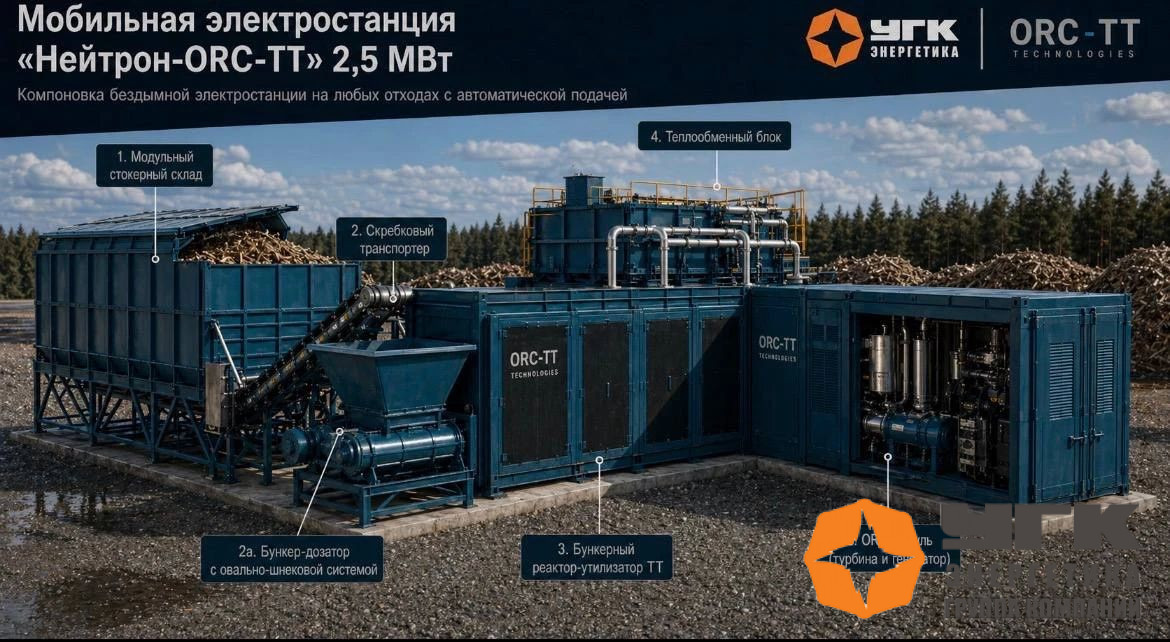
In the new modification of the recovery unit, the developers have moved away from using thermally expanded graphite (TEG) sorption filters in favor of a dynamic combustion recirculation system.
During the combustion of pyrolysis gases inside the housing, a colorless gas stream is formed. A receiving hood is installed directly above the chimney, connected via an ejector to two pipes with high-pressure fans. This system captures residual smoke particles and draws them back into the point-source combustion loop.
The flue gas recirculation system has proven to be significantly more efficient, simpler, and more reliable than mechanical and graphite filters.
For pulp and paper mills (PPM) or timber industry complexes, the accumulation of BWW, bark, sawdust, and slabs at landfills creates a serious environmental and financial burden. This project demonstrates the transformation of non-liquid wood biomass into a highly liquid resource.
The “Neutron-ORC-TT” mobile waste-to-energy plant provides electricity production witha cost of 0.91 – 1.5 rubles per kWh..
Similar complexes can be installed directly at landfills across many regions of Russia. The generated power can be used to cover the internal needs of PPMs and woodworking facilities, power local infrastructure, or supply energy to crypto farms and modular data centers.
The mobile waste-to-energy center is designed as a complete technological solution, including:
The use of flue gas recirculation allows such complexes to be located in close proximity to residential areas and logging sites without the risk of violating environmental regulations.


